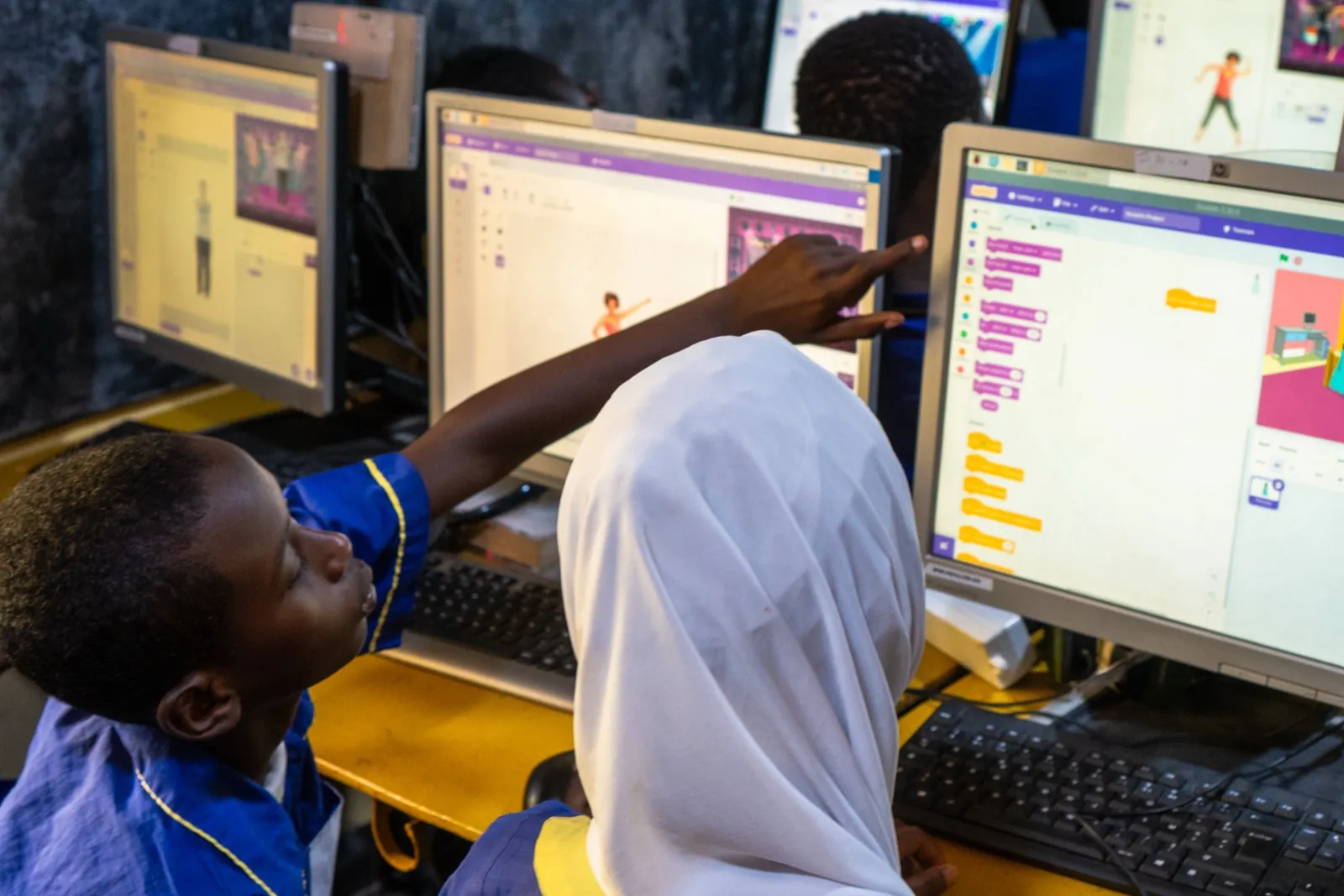
Your gift is a child in The Gambia or Uganda coding a first program, practising at their own pace, looking the world up. And it keeps doing that for years, because the school owns and runs its lab. Your support funds the leverage around it: the things that make every lab cheaper, better and easier to start.
KUBO is built so that every contribution keeps working long after it is spent.
Hardware and software are open, so every euro goes to equipment, training and support. Nothing leaks away into licences.
Five pilot schools across two countries work with KUBO every day. You fund what already works, not an experiment.
Schools own their lab, teams get trained and support stays available. The first lab ran nine years on its original computers, and your impact keeps running like that, instead of gathering dust.
Low-power workstations, reused peripherals and an offline server keep costs small. An indication: a server is about €320, a server with five seats about €1,600, a full 25-computer lab about €9,000.
For the givers who compare before they give: the arithmetic behind the impact.
€5,000, once, makes every case after it an estimated ten times cheaper. A printed case costs about €60 today, so that is roughly €1,300 off every future 25-seat lab, and every school that ever joins pays less because of it.
The first lab ran nine years on its original computers. A €9,000 lab over nine years is less than €1,000 a year for a whole school's IT, and the school carries its own running costs, so your gift is not consumed by operations.
A matched gift finishes a lab the school is already paying for. Your euro moves alongside the school's own euro, and ownership stays where it keeps the lab alive.
The biggest impact right now: one investment lowers the price of every future lab at once.
We went from one school to five pilot schools across two countries. KUBO is proven, and many more schools want it.
One piece is missing. Every KUBO X, the protected workstation at each seat of a lab, still gets its case 3D-printed one at a time. The fix is a one-time investment: an injection mold, a steel form that works a bit like a waffle iron.
Donations run through Afrodidact, the nonprofit behind KUBO. Belgian donors, individuals and companies alike, receive a tax certificate for gifts of €40 or more, and companies can request an invoice when donating. If the campaign raises more than the mold needs, the surplus goes into the next production steps, starting with the packaging.
The mold is the campaign of today. The work behind it runs all year, and it can use your support too.
Behind every lab sits ongoing work: fair pay for the people who build and maintain KUBO, developing the packaging, organizing computer clubs, and creating teaching materials that fit the classrooms we serve. General support keeps that engine running.
Schools invest in their own lab, and that ownership is part of why KUBO lasts. For some schools the first step is simply too high. Matching works like a menu: complete a school's server (about €320), a first classroom corner (about €1,600) or a full 25-computer lab (about €9,000), or any part of one, while the school stays the owner. Interested? Write to info@kubo.global.
Smaller gifts land just as concretely: €35 puts our kit on a seat, €80 buys a refurbished screen set, €184 completes a whole seat, €320 gives a school its library server.
Every contribution counts, and donations run through Afrodidact, the nonprofit behind KUBO.
KUBO is a project of Afrodidact VZW, a Belgian nonprofit (BE 0883.177.179). Donations are received and accounted for by Afrodidact: gifts of €40 or more qualify for a Belgian tax certificate (for Belgian taxpayers), and the annual reports are public at afrodidact.org/annual-reports.